A browser-based alternative to Redis Insight
Planche is an alternative for developers whose Redis sits next to a SQL database or a search cluster and who want one client for all of them. Its interface runs in a browser and the local Planche Agent holds the Redis connection. Redis Insight is the official Redis GUI from Redis Ltd., a free desktop application that is also published as a Docker image, and it covers more of Redis itself.
Open Planche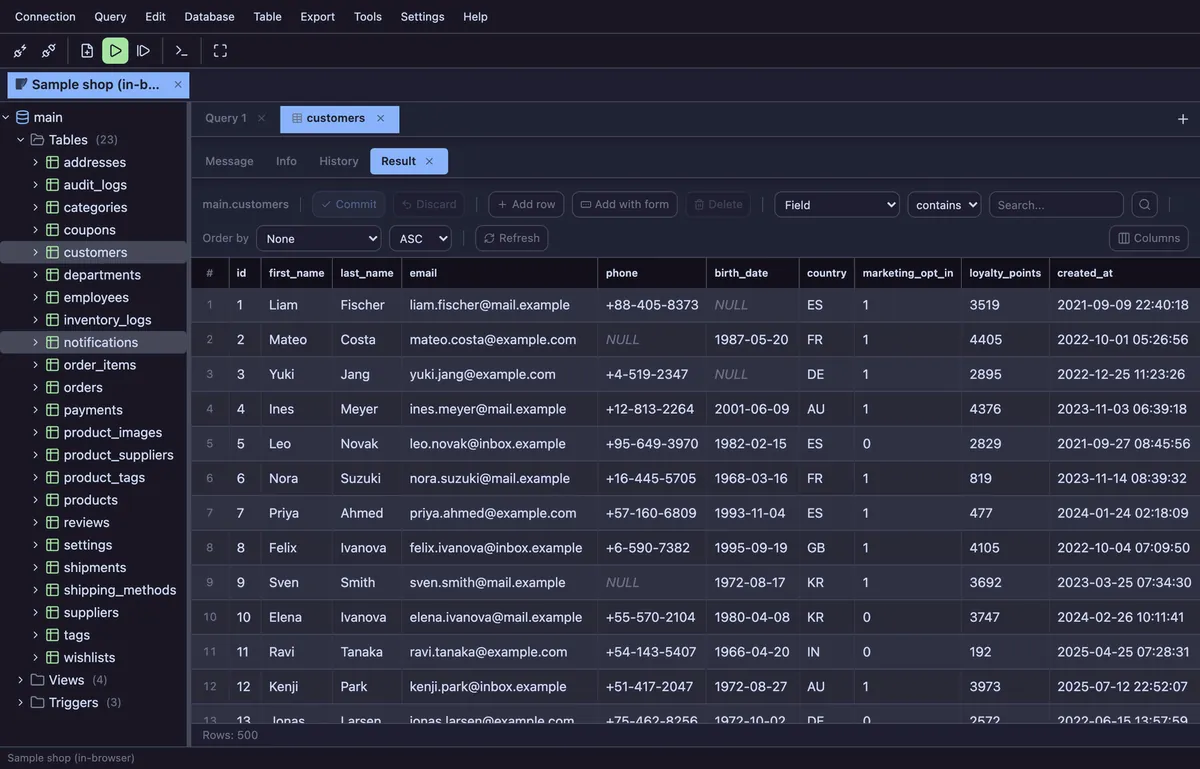
| Consideration | Planche | Redis Insight |
|---|---|---|
| Interface | Browser-based UI; a local agent (npx planche) connects to Redis | Desktop application for Windows, macOS and Linux, or a Docker image served on port 5540 |
| Databases | Redis next to MySQL, MariaDB, PostgreSQL, SQLite, SQL Server, Oracle, Elasticsearch and OpenSearch in the same window | Redis only, including Redis Cloud, Redis Software and Azure Managed Redis discovery |
| Key editing | Strings, hashes, lists, sets, sorted sets and streams; RedisJSON values viewed and replaced as whole documents | CRUD for every core type plus JSON, vector sets and stream consumer groups (pending messages, acknowledge, claim) |
| Memory analysis | Scans every key up to a chosen cap of 10k, 100k or 1M keys; no extrapolation | Analyses up to 10,000 keys and extrapolates beyond that, with historical reports |
| Operations tools | Server info, slow log, client list, Pub/Sub, MONITOR, delete keys by pattern | Profiler (MONITOR), slow log, Pub/Sub, bulk delete, Search workspace for Redis Search indexes |
| Cluster and Sentinel | Not supported yet: a cluster node shows its own keys and names the owner of any other key | Supported |
| Safety | Read-only profiles refuse every write; FLUSHDB/FLUSHALL and pattern deletes ask for confirmation; AUTH passwords masked in history | Confirmation dialogs for deletion |
| Price and licence | Free, proprietary; SSH tunnels and a few cross-database tools require Pro | Free; source available under the SSPL |
When Planche is the better fit
Choose Planche when Redis is one of several stores you look at in a day — a cache in front of PostgreSQL, sessions next to MySQL, a search index fed from the same rows — and you want them in one client with one set of guard rails. The key and the table row it caches are one click apart in the same window.
Planche also fits when you would rather not install a desktop application: the Redis client runs on planche.dev or on the copy the agent serves, and connection profiles stay in your browser.
When Redis Insight may be the better fit
Choose Redis Insight when you run Redis Cluster or Sentinel, use stream consumer groups, Redis Search or vector sets, or want Redis Copilot and the built-in tutorials. It is maintained by the company behind Redis and follows new Redis features first. If Redis is the only database you work with, its deeper coverage of Redis outweighs having SQL engines in the same window.
Questions
Is Planche a free Redis Insight alternative?
Yes. Redis support in Planche — the key browser and editors, console, server info, slow log, clients, Pub/Sub, MONITOR, memory analysis and delete by pattern — is free with no account. SSH tunnels require Pro. Redis Insight is also free.
Does Planche support Redis Cluster or Sentinel?
Not yet. Connected to a cluster node, Planche shows that node’s keys and, for a key held elsewhere, names the node that owns it instead of failing silently. Redis Insight supports both.
Does Planche work with Valkey, KeyDB or Dragonfly?
Planche speaks the Redis protocol through ioredis and works with servers that implement the same commands. Features that rely on MEMORY USAGE, SLOWLOG or CONFIG GET show what the server answers and say so when it refuses.
Does my Redis password go to a Planche server?
No. The connection runs in the Planche Agent on your own machine, and the browser talks only to 127.0.0.1. See the Redis documentation.
Can Planche analyse memory on a large database?
Yes. Memory analysis scans with SCAN and asks MEMORY USAGE for each page of keys in one pipeline; 20,000 keys take about a second. You choose a cap of 10k, 100k or 1M keys, and every key under the cap is measured rather than extrapolated.
Free to use
Planche has a free tier that needs no account and uploads none of your data — connection profiles live only in your browser. A few advanced features need Pro; see pricing.